

So, you are about to become parents. Your to-do list is huge, and so is the shopping list. I know your feeling. I was completely overwhelmed too. All those brands, all those lists, and no idea who (or what) to believe.
Today, let's take diapers. (By the way, I compared stroller brands here.) What kinds of diapers are there? Are they different for boys and girls? (No.) How many do you actually need? How do you choose? And are the cheapest ones okay? (Yes!)
We'll go through every one of these questions below. Let's figure it out together.
The short answer
- Every disposable diaper is built the same way: a soft top layer, an absorbent core of wood pulp and super-absorbent gel, and a waterproof but breathable outer layer. Brands differ in softness, fit, how fast they feel dry, what's added (perfume, lotion), eco labels and price.
- A newborn uses 8 to 12 diapers a day. Size 1 (2–5 kg) only lasts the first weeks, so don't stock up.
- Cheap diapers are fine. In Test-Aankoop's 2026 test of 20 diapers, store brands at around €0.10 each scored on par with the best, and Lidl's Lupilu was the champion for dryness and breathability.
- In Dutch shops you'll mostly find Pampers and the own brands of Kruidvat, Etos and Albert Heijn. Huggies, Lillydoo, eco brands like Bambo Nature and budget picks like Amazon's own diapers are easiest to buy online.
- The best diaper is the one that fits your baby. Try a few brands before you buy in bulk.
How a diaper is made (and why they're not all the same)
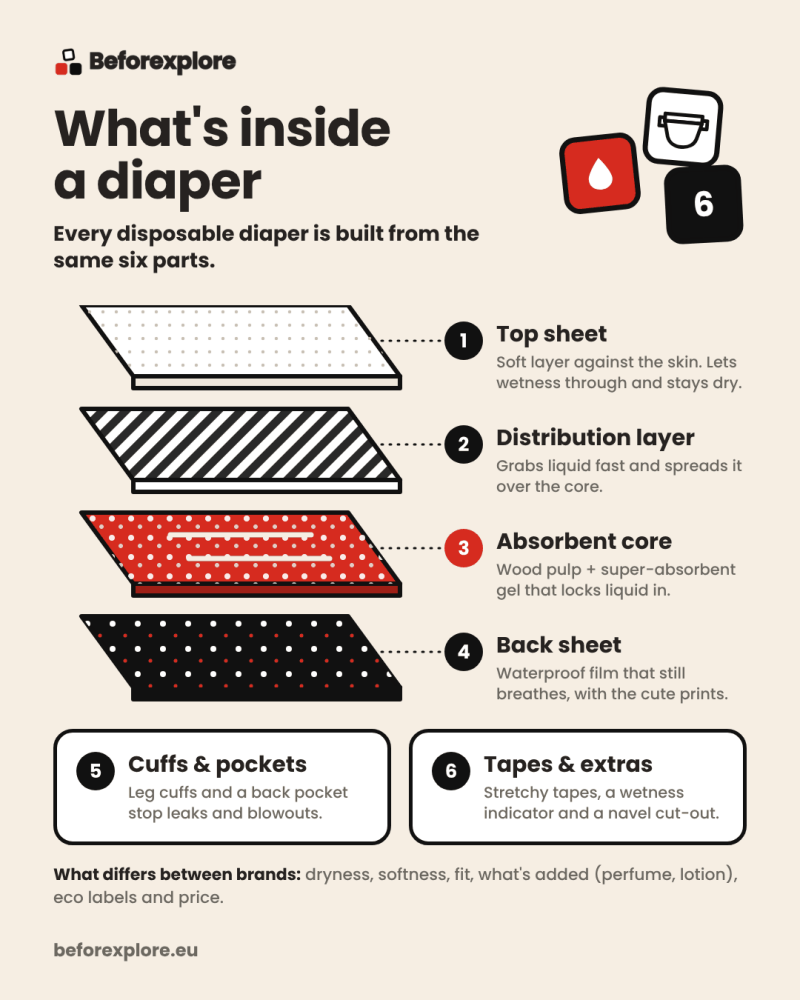
Open up any disposable diaper and you'll find the same layers, from the side that touches your baby to the outside:
- Top sheet. The soft layer against your baby's skin, usually a nonwoven fabric of polypropylene. It lets wetness straight through and stays as dry as possible itself. Some brands add a skin lotion here; eco brands use plant-based materials.
- Distribution layer. A thin layer just underneath that grabs liquid fast and spreads it over the core, so it doesn't pool in one spot.
- Absorbent core. The heart of the diaper: fluff pulp (cellulose from wood) mixed with granules of super-absorbent polymer, which turn liquid into gel and lock it in. Many cores have channels that spread the wetness and stop the diaper from sagging.
- Back sheet. A thin waterproof film that still lets water vapour out (that's what "breathable" means on the pack), covered with a soft outer layer with the cute prints.
- Elastics, cuffs and pockets. Stretchy leg cuffs with anti-leak edges, a waistband, and on many newborn diapers a pocket at the back for runny poo. Kruidvat calls it a Capture Pocket, Etos a Poo Pouch and Pampers a Stop & Protect pocket.
- Closures and extras. Stretchy side tapes, a wetness indicator stripe that changes color when your baby has peed, and on the smallest sizes a cut-out for the umbilical cord stump.
What actually differs between brands
- Dryness. How fast the top layer feels dry again after a pee, and how much liquid comes back to the skin when your baby lies on it. This is exactly what consumer testers measure.
- Absorbency. How much the core holds before it leaks. It matters most at night.
- Softness and breathability. The top sheet decides how soft the diaper feels; the back sheet decides how much moisture can escape.
- Fit. The cut, the elastics and the waistband. As Kruidvat puts it, some diapers just fit a little differently. That's why one brand leaks on your baby and not on your friend's.
- What's added, or left out. Perfume, lotion, latex and dyes. Many brands now advertise 0% perfume and lotion.
- Eco credentials. Certified wood pulp, plant-based materials, recycled packaging, green energy in the factory.
- Price. From €0.10 to €0.56 per diaper in Test-Aankoop's 2026 test.
Labels you'll see on the pack
- FSC: the wood pulp comes from responsibly managed forests.
- EU Ecolabel: the EU's official environmental label, which checks the whole life cycle of the diaper. Kruidvat, Etos, AH Beregoede and Bambo Nature diapers carry it.
- Nordic Swan Ecolabel: the Scandinavian ecolabel, which guarantees few hazardous substances and no microplastics. Bambo Nature and Moomin Baby have it.
- OEKO-TEX: tested for harmful substances. Test-Aankoop advises looking for it, especially if your baby has sensitive skin.
- TCF or ECF: how the pulp was bleached. TCF means totally chlorine-free, ECF means without elemental chlorine.
Types of diapers (and the Dutch words you will see in shops)
For the first months, your baby will wear ordinary tape diapers. Everything else is a variation for a specific moment.
- Tape diapers: luiers. The classic diaper with stretchy tapes (plakstrips). This is what you'll use from day one.
- Newborn diapers: newborn luiers. Sizes 0 to 2, extra soft, often with a back pocket, a wetness indicator (plasalarm) and a navel cut-out (naveluitsparing).
- Diaper pants: luierbroekjes. Pull-up pants that are easier once your baby starts wriggling away during changes. At Albert Heijn, for example, they start at size 3.
- Night diapers: nachtluiers. Extra absorbent for long nights, like Pampers Night Pants. A bigger size also absorbs more, so going one size up at night can help too.
- Swim diapers: zwemluiers. They don't swell up in the water, but they don't hold pee either: they only catch poo. Whether they're required differs per pool, so check before your first swimming lesson. You'll find disposable ones from Huggies, Pampers and Kruidvat's own brand.
- Eco diapers: ecologische luiers. Plant-based materials and ecolabels. More on these brands below.
- Washable diapers: wasbare luiers. Reusable cloth diapers, plus hybrids with a washable cover and a disposable insert.
Diaper sizes in the Netherlands
Sizes go by your baby's weight, and every brand draws the lines a little differently. Roughly:
- Size 0 (extra small, for premature babies): up to about 3 kg. Most babies skip it.
- Size 1 (newborn): 2–5 kg.
- Size 2 (mini): about 3–8 kg.
- Size 3 (midi): about 5–10 kg.
- Size 4 (maxi): about 8–15 kg.
- Size 5 (junior): about 11–18 kg.
- Size 6 and up (extra large, XXL): 13 kg and more.
Sizes with a plus (4+, 5+) are in-between sizes. Time to go up? If you have to stick the tapes towards the sides instead of on the tummy, or the diaper keeps leaking, try one size bigger.
Are there diapers for boys and girls?
No. The baby diapers in Dutch shops are unisex: one diaper for every baby, just with different prints.
The only place you'll still see boy and girl versions is night pants for much older kids, like Huggies DryNites for ages 4 and up.
How many diapers do you need?
A newborn needs 8 to 12 diapers a day, because in the first weeks you change your baby at almost every feed, every 2 to 3 hours. That's around 60 to 80 diapers in the first week alone.
- First weeks: 8–12 a day.
- Size 1: most babies outgrow it within a few weeks. A baby who was born big can be ready for size 2 after just a couple of weeks.
- Later: about 5 a day on average, or roughly 1,800 a year.
- In total: Dutch children are potty trained at 3 years and 2 months on average, and use around 5,000 disposable diapers along the way.
A practical plan: don't stock up on one brand before the birth. Get size 1 in a few different brands instead, and see which one fits your baby best. My Beforexplore diaper box is made for exactly this: several brands in newborn size, in one box. Once you've found your favorite, buy it in bulk.
Are cheap diapers OK?
Yes. Store-brand diapers at around €0.10 each hold their own against the big names, and they save you hundreds of euros a year.
- The test. Belgian consumer organization Test-Aankoop tested 20 diapers from 14 brands in 2026, including Pampers, Huggies, Albert Heijn, Kruidvat, Jumbo, Lidl and Aldi. The three best buys cost about €0.10 a diaper and scored 63 to 65 points, on par with the best diapers in the test. Lidl's Lupilu was the champion for breathability and dryness, and felt very soft too. Albert Heijn's Beregoede diapers made the overall top 10.
- Who makes them. Store brands come out of big specialist factories. Belgian company Ontex makes diapers for retailers across Europe, plus its own eco brand, Moltex. Lidl's Lupilu diapers are made by Drylock, a Belgian manufacturer that has also produced for Lillydoo.
- Even a hospital chose one. Ghent University Hospital in Belgium signed a four-year deal for Kruidvat's own diapers, while hospitals usually pick an A-brand like Pampers.
- The savings. At five diapers a day, the gap between the cheapest (€0.10) and the most expensive (€0.56) diaper in the test adds up to about €840 a year.
The honest caveat: pricier diapers often perform a little better, so you may change slightly less often, which closes part of that gap. Sometimes you simply prefer a softer brand. And sometimes a diaper just doesn't fit your baby, or your baby's skin reacts. Then switch. The only way to know is to try.
The big brands
Pampers
In Dutch and Flemish, "pampers" is practically the word for any diaper. Belgian testers even call all 20 diapers in their test pampers. The brand belongs to Procter & Gamble and sits on every shelf.
- Lines to know:
- Premium Protection: Pampers' softest diaper, with a size 0 for babies up to about 3 kg.
- Harmonie: 0% perfume and lotion, hypoallergenic and dermatologically tested, with a Stop & Protect pocket at the back.
- Baby-Dry: the everyday, more affordable Pampers line.
- Pants: Baby-Dry Pants, Premium Protection Pants, Harmonie Pants and Night Pants.
- Good to know: Pampers is almost always on promotion somewhere, and big boxes bring the price right down.
- Where to buy: everywhere, from Kruidvat and Albert Heijn to bol.com and Amazon.nl.
Huggies
The other big name, from Kimberly-Clark. In Dutch shops you will mostly spot it as Little Swimmers swim diapers; the diapers themselves are easiest to buy online, often in big boxes.
- Lines to know:
- Extra Care, the successor of Huggies Elite Soft. It's hypoallergenic, with soft pads at the front that absorb in seconds and a second zone at the back for runny poo.
- Little Movers (pants) is the line for active babies, from size 3.
- Also: Little Swimmers (at Kruidvat and Etos) and DryNites, night pants for older kids.
- Where to buy: bol.com and Amazon.nl.
Store brands (huismerken)
Dutch drugstores and supermarkets all sell their own diapers. They're cheap, they're everywhere, and they test well.
Kruidvat
The Dutch default: Kruidvat says its own diapers are the best-selling in the Netherlands.
- Lines to know:
- Kruidvat and Kruidvat NewBorn (yellow pack): a Capture Pocket against blowouts, a wetness indicator, and no lotion, perfume or latex. EU Ecolabel and FSC. About €0.15 a diaper in size 1, before promotions.
- Pure & Soft (green pack): ultra-soft materials of natural origin, ClimatePartner certified, for hardly more money.
- Good to know: you can swap an unopened pack of Kruidvat diapers for one size up or down in any store, even without a receipt. NewBorn size 1 also comes in a 20-diaper smallpack, handy for a first try.
Etos
Etos relaunched its own diapers (Soft & Protect) with softer material, an elastic closure and a Poo Pouch against leaks in sizes 1 and 2. They carry the EU Ecolabel.
- Good to know: Etos sells a 20-diaper newborn trial pack, a cheap way to test the fit. There's also a line with Woezel & Pip prints, and you'll find Etos diapers at Albert Heijn too. With a Mijn Etos loyalty card, Etos own-brand diapers are 10% off (not combined with other deals).
Albert Heijn, Lidl, Aldi and Jumbo, PLUS, Spar, Dirk and more
AH Extra droog & zacht (extra dry and soft): a very soft top layer and better spread of moisture over the core.
Every supermarket chain has its own budget diapers. Lidl's Lupilu stands out as the 2026 Test-Aankoop champion for breathability and dryness. Aldi and Jumbo sell their own diapers as well.
Bonbébé is the baby brand of Superunie, which buys for a group of Dutch supermarkets, so you'll find the same diapers at PLUS, Spar, Dirk and DekaMarkt, among others. The BonBebe diapers have "magical tubes": channels in the core that spread the wetness, plus a soft top layer and anti-leak edges, for up to 12 hours of protection. A tester at Ouders van Nu called the diaper pants one of the best on the supermarket shelf: soft, a good fit and absorbent, though not the cheapest.
Budget brands online
If you order diapers online, like I do, you'll come across a few more budget names.
Amazon's own diapers (by Amazon, formerly Mama Bear)
Amazon sells its own diapers. For years they were called Mama Bear; now they're sold as "by Amazon", but it's the same product. The Ultra Dry line has channels in the core and double elastic barriers at the legs. There's also a version with Disney prints.
Where to buy: only on Amazon.
Confy
A Turkish brand from the hygiene company Lidersan, sold mostly in big value packs and monthly boxes. The online drugstore Plein.nl sells Confy too.
Gentle, premium and eco brands
These cost more, and most are sold online. Parents choose them for sensitive skin, for softness, or for the planet.
Rascal + Friends
A British brand at Kruidvat and Etos. Its Premium diapers have no latex, lotion or fragrance, use water-based inks, and have a deep pocket against blowouts. Often on a 2-for deal.
Lillydoo
A German brand from Frankfurt, founded in 2015, that sells mainly through its own webshop: one-off orders, or a subscription (LILLYDOO+) that's cheaper per pack. The diapers are free from perfume, lotion and dyes, with chlorine-free (TCF) pulp.
Bambo Nature
Danish eco diapers with a long list of labels: Nordic Swan Ecolabel, EU Ecolabel, FSC and Asthma Allergy Nordic. Dermatologically tested, with 0% perfume, parabens and lotion. Sold online, for example at De Online Drogist.
Moomin Baby (formerly Muumi Baby)
Finnish eco diapers, developed with the Allergy, Skin and Asthma Federation of Finland. No perfume, lotion or latex, chlorine-free pulp and the Nordic Swan Ecolabel. Sold online.
Naty
A Swedish eco pioneer since 1994, formerly called Eco by Naty. It replaces fossil-based plastic with plant-based materials where it can. Order from Naty's own webshop, as single packs or a subscription.
Kit & Kin
A British eco brand founded by former Spice Girl Emma Bunton. The diapers are hypoallergenic and plant-based, made without chlorine, latex, lotion or fragrance, with a flash-dry layer and channels for up to 12 hours of leak protection. Parents love the animal prints, though some say the sizing runs small.
- Where to buy: online. You'll find it online, for example on Amazon, and it costs more here than in the UK and Ireland.
Japanese diapers: Merries and Moony
Some parents swear by Japanese diapers for their softness. Merries comes from Kao, Moony is made by Unicharm. They're not sold in Dutch shops, only in import webshops and on marketplaces, at a much higher price. Japanese sizes go by letters (NB, S, M, L) instead of numbers, so check the weight on the pack.
Washable diapers
Reusable cloth diapers have come a long way: no more safety pins. Milieu Centraal calls them the most sustainable option, and they save €500 to €700 per child, washing costs included. Several municipalities, such as Heerenveen, Kampen and Deurne, even give a subsidy, so check your gemeente's website.
At a glance: diaper brands in the Netherlands compared
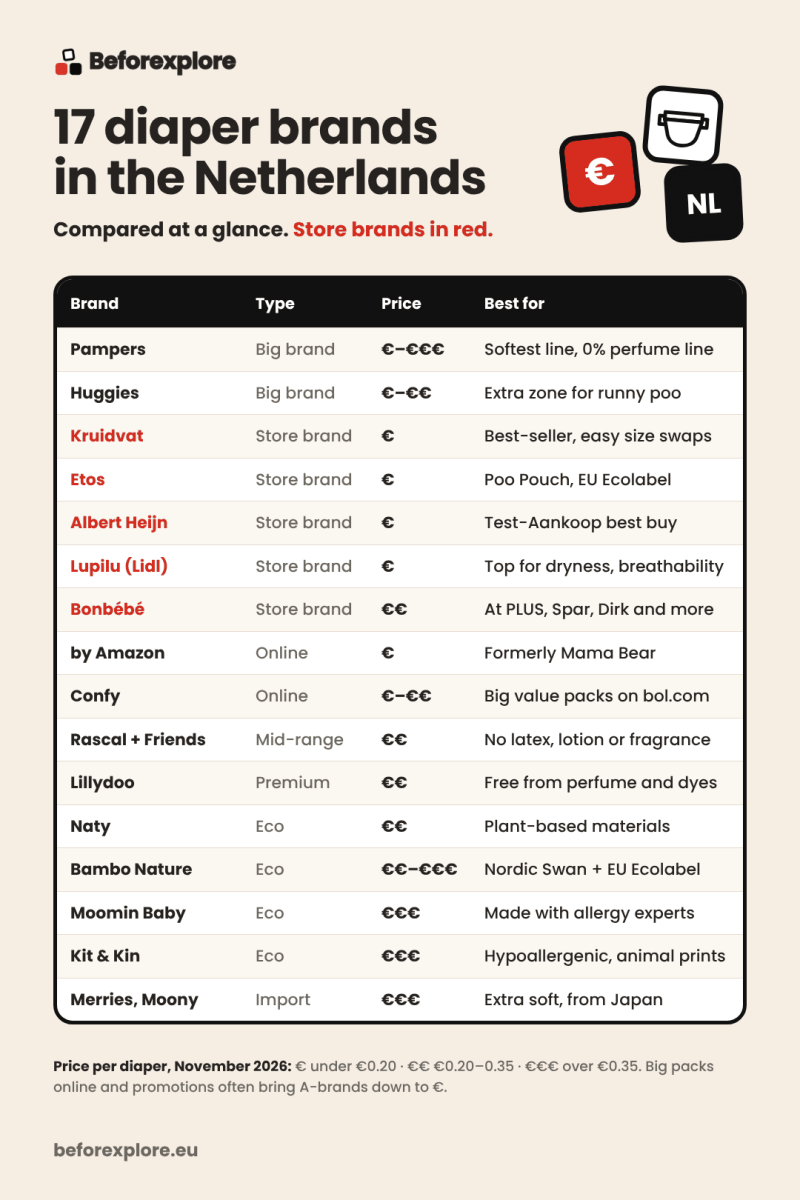
Price per diaper, November 2026: € under €0.20 · €€ €0.20–0.35 · €€€ over €0.35. Big brands land in the € column only in big boxes. Prices and deals change all the time, so treat this as a starting point.
Not sponsored: Beforexplore isn't affiliated with any of these brands.
How to choose diapers
Start with an affordable diaper that fits, and only pay more when you have a reason to.
- Fit comes first. A diaper that's too small or tight can chafe, and one that's too big can leak (Test-Aankoop). In the first weeks, a navel cut-out keeps the waistband off the umbilical cord stump.
- Leaks or blowouts? Check the size first: if the tapes reach the sides instead of the tummy, go one size up. Still leaking? Try a brand with a different cut, not necessarily a more expensive one.
- Pull the leg cuffs out. After closing the diaper, run a finger along the leg openings so the inner anti-leak edges stand up and point out. Tucked-in cuffs are a classic cause of side leaks.
- Red skin? Change more often, let the bottom air for a bit, and try a diaper without perfume or lotion. If the rash doesn't go away, ask the consultatiebureau or your huisarts.
- Leaks at night? Go one size up for the night, or try night pants.
- Compare the price per diaper, not per pack. Packs run from 20 to 324 diapers.
- Big boxes of A-brands can be a bargain. Huggies and Pampers in big packs online can cost close to store brands.
- Stock up only once you know. Drugstores and supermarkets run diaper deals all the time (1+1 gratis, 2e halve prijs). Save them for the brand that works for your baby.
Quick picks by situation
Tight budget
Kruidvat, Etos, AH Beregoede, Lidl Lupilu; online: by Amazon, Confy
You order everything online
Big boxes of Huggies or Pampers, by Amazon, Confy
Sensitive skin and soft
Pampers Harmonie, Bambo Nature, Moomin Baby, Lillydoo, Kit & Kin
Eco-minded
Bambo Nature, Naty, Moomin Baby, Kit & Kin, Kruidvat Pure & Soft, washable diapers
Blowouts in the first weeks
Newborn diapers with a back pocket: Kruidvat NewBorn, Etos, Pampers Harmonie, Rascals
Leaks at night
One size up, or night pants like Pampers Night Pants
Swimming lessons
Huggies Little Swimmers, or a washable swim diaper like Bambino Mio
What I used (and what I would do differently)
With my first baby, we used only Pampers. We tried them, they were fine, and after that it was easy to order whole boxes on Amazon. Sometimes we bought Etos or Kruidvat diapers, but ordering from Amazon was simply more convenient.
With my second baby, I wanted to try a bit of everything. And we tried almost every brand! Now I can say that Pampers turned out not to be our favorite.
Honestly, what we buy most is Huggies. They are also easy to order in big packs on Amazon, but they are much softer, and they last longer. Bambo Nature is excellent too! It's just often more expensive. I also really like Lillydoo, but I'll admit it: I don't love subscriptions, so I tend to steer clear of their model.
If I hadn't been afraid of big packs at the start, and had gotten a few different brands as a gift, I would have been much braver with my first baby. And we would have found our favorites much sooner!
Frequently asked questions
What are the most popular diaper brands in the Netherlands?
Pampers and the store brands. Kruidvat says its own diapers are the best-selling in the country, and the Etos and Albert Heijn brands are on every corner too. Huggies is popular as well, mostly bought online.
How many diapers does a newborn need per day?
Around 8 to 12 in the first weeks, because you change your baby at almost every feed. Later it drops to about 5 a day on average.
Which diaper size do I need for a newborn?
Most newborns start in size 1 (2–5 kg) and outgrow it within a few weeks; a baby who was born big, often within a couple of weeks. Size 0 is for premature or very small babies up to about 3 kg.
Are cheap diapers as good as Pampers?
Often, yes. In Test-Aankoop's 2026 test, the best-buy store brands at about €0.10 a diaper scored on par with the best diapers tested. A pricier brand may still suit your baby's shape or skin better, so try a few.
How much do diapers cost in the Netherlands?
From about €0.10 to €0.56 per diaper (Test-Aankoop, 2026). Milieu Centraal puts the whole diaper period at around €1,270 per child.
When should I switch to diaper pants?
When changing your baby lying down starts to feel like wrestling. Most brands sell pants from about size 3 or 4.
Do babies need swim diapers in Dutch pools?
Often, yes, but the rules differ per pool. Swim diapers don't hold pee, so put one on just before your baby goes into the water.
Where can I buy diapers in bulk?
Kruidvat and Etos sell big boxes of their own brands (volumedoos, maandbox), and bol.com and Amazon.nl have big packs of Pampers and Huggies. Amazon's own diapers come in monthly boxes too, and Confy sells big value packs on bol.com.
Can used diapers go in the GFT bin?
No. Used diapers go in the restafval (general waste): they're not allowed in the GFT bin for vegetable, fruit and garden waste. Some municipalities have special diaper containers (luiercontainers), where you drop off used diapers in special bags. Check your gemeente's website or waste app.
About the author
I'm Anna, a mom of two and the founder of Beforexplore. Between my two kids, I've changed thousands of diapers of almost every brand on the Dutch shelf, and I write the guides I wish I'd had: real recommendations, not another search.
The diaper we love most is the one we found by trying, not by guessing. That's exactly why I created the Beforexplore diaper box: full packs of several diaper brands in newborn size, in one box. A lovely kraamcadeau, and the easiest way to find your baby's favorite.
Explore parenthood, step by step, box by box.