

You have been living in a world without kids, busy with your favorite grown-up things. And now you have found out you are going to be a parent. A whole new world opens up, and everything in it works differently.
It is like stepping from one reality into another. This one has its own brands, its own communities, its own tried-and-tested routines and life hacks.
When I first sat down to figure out what a baby actually needs, I was drowning in information. So much stuff! What is just advertising, and what is a proven brand that is worth every euro? Let us figure it out together.
Today it is strollers: the types, the stroller brands you will find in the Netherlands, what parents love about each one, and what you actually need (and what you can skip).
The short answer
- The best-known stroller brands in the Netherlands are Dutch: Joolz, Bugaboo, Mutsy and Easywalker. In a 2024 Consumentenbond survey of 500+ parents, Joolz led with 23%, followed by Bugaboo (11%) and Maxi-Cosi (10%).
- Budget: roughly €250 for a simple buggy, and €600 to €1,300 or more for a full stroller with carrycot and seat.
- For a newborn, you need a carrycot (reiswieg). Dutch consumer testers call it the best way to carry a young baby in a stroller.
- Second-hand is completely normal here. About a quarter of Dutch parents use a second-hand stroller, for example from Marktplaats.
- Push a few strollers in a real store before you decide. And don't let this one purchase eat all your preparation time.
Types of strollers (and the Dutch words you'll see in shops)
In Dutch shops, the default is the 3-in-1 stroller: one frame that takes a carrycot, a seat and an infant car seat. Everything else is a variation on that idea.
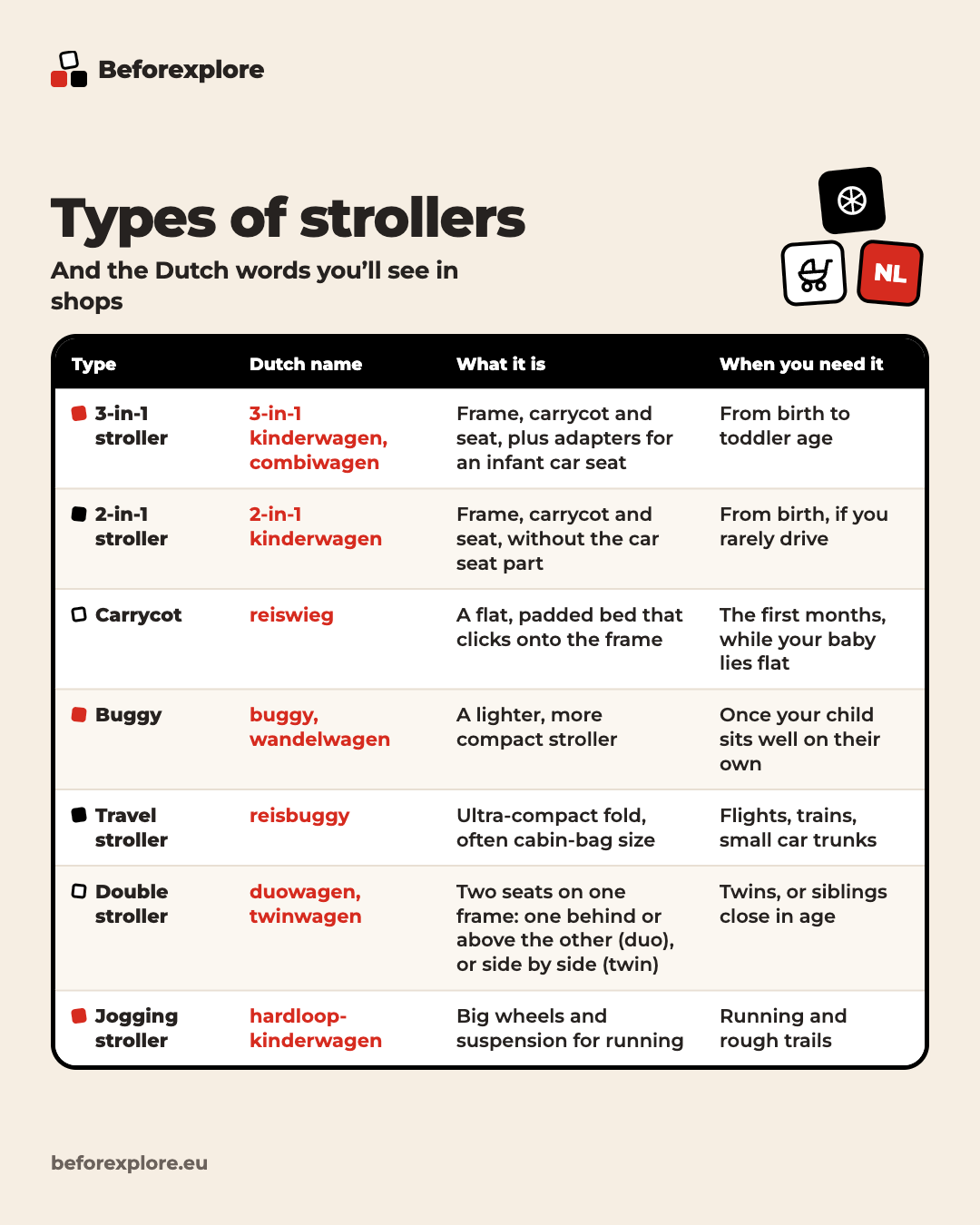
About 1 in 10 strollers in the Netherlands is bought as a double, and another 1 in 10 parents picks a single that converts into one later. Models with one seat behind or above the other are more popular than side-by-side ones (Consumentenbond, 2024).
What a newborn actually needs
A newborn should lie flat, so the carrycot is the one part worth having from day one. Consumentenbond advises a carrycot that fits your baby until 6, ideally 9 months: at least 80 cm long inside.
A reclining seat is not the same thing. Even fully reclined, the angle stays at about 150°, and your baby lies in a harness.
Check the price tag carefully: with many 3-in-1 models, the cheapest version includes only the seat, and the carrycot costs extra.
The infant car seat that clicks onto the frame is handy for car trips. In the Netherlands, most people call it a maxi-cosi, after the brand that started here as a car-seat maker in 1984.
Dutch stroller brands
For a small country, the Netherlands punches far above its weight in strollers. Two of the world's best-known premium brands, Bugaboo and Joolz, were born in Amsterdam.
Bugaboo
The brand that turned the stroller into a design object. Max Barenbrug started it as his graduation project at the Design Academy Eindhoven, founded the company in Amsterdam in 1996, and the first Bugaboo hit Dutch streets in 1999.
- Models to know: Fox 5 Renew (all-terrain), Dragonfly Plus (compact city stroller), Butterfly 2 (ultra-compact, cabin-bag size) and Donkey 6 (side-by-side double, also sold as a single).
- Why parents love it: smooth one-hand steering, a modular system with lots of accessories, and strong resale value. In the Netherlands, more Bugaboos are bought second-hand than new.
- Good to know: Bugaboo sells refurbished strollers on its own website.
Joolz
Founded in Amsterdam in 2004, Joolz is the most popular stroller brand in the country right now. In the 2024 Consumentenbond survey, 23% of parents had one, and Joolz was also the brand parents would most often recommend.
- Models to know: Day (the everyday all-rounder), Geo (grows from single to double or twin), Hub (compact city stroller) and Aer (light travel buggy with a one-hand fold).
- Why parents love it: calm, clean design, comfort for the baby, and a real sustainability story: Joolz plants trees for every stroller sold.
- Good to know: since July 2025 Joolz belongs to Bugaboo, but the two brands keep operating separately. Joolz also advertises a 10-year warranty that passes to the next owner if the stroller was registered, so check the conditions on joolz and ask a second-hand seller about registration.
Mutsy
A long-standing Dutch family favorite. Mutsy paused production for a while and came back at the end of 2023 with new models.
- Models to know: Nexo+ (a 3-in-1 of about 10 kg with the carrycot included) and Flow (from birth up to 22 kg with the matching carrycot).
- Why it's worth a look: a complete stroller with carrycot at a mid-range price. Consumentenbond lists the Nexo+ at around €600.
- Good to know: buying an older Mutsy second-hand? Check that you can still get spare parts for that model.
Easywalker
An Amsterdam brand, founded in 1989, that's loved for practical strollers at fair prices. Together with Joolz, Bugaboo and Mutsy, it was one of the four most popular brands in Consumentenbond's 2020 parent survey.
- Models to know: Harvey 5 (can be extended into a double or twin), Jimmey (all-terrain, with suspension on all four wheels), Rudey (comes with a carrycot) and compact buggies from around €250.
- Good to know: with heavy use the wheels wear down, but replacement wheels are available.
Dubatti
A smaller Dutch brand with a different idea: on the Dubatti One, the seat converts into a carrycot, so you don't buy a separate one. It comes with plenty of extras and a huge shopping net at the back.
- Good to know: it's on the heavy side. Consumentenbond lists the One E6 at 14.5 kg.
Maxi-Cosi
Maxi-Cosi started in the Netherlands in 1984 as a car-seat brand and is now owned by the Canadian group Dorel. It also makes 3-in-1 strollers, travel systems and buggies, and every one of them takes a Maxi-Cosi car seat.
- Good to know: it was the third most popular stroller brand in the 2024 survey, and unlike Bugaboo it's mostly bought new.
Nuna
A premium brand with Dutch roots that started in 2007 with a high chair. Today it's best known for car seats and sleek strollers like the MIXX next, TRIV next and the compact TRVL.
- Good to know: Bugaboo's own infant car seats are made by Nuna.
International stroller brands sold in the Netherlands
Dutch stores and webshops carry dozens of foreign brands too. These are the ones you'll meet most often, from premium to budget-friendly.
Premium favorites
- Cybex (Germany): fashion-forward design and a strong safety reputation from its car seats. The range runs from the luxurious Priam to compact travel strollers and the Gazelle S, which converts into a double.
- Stokke (Norway): the Xplory X lifts your baby high, closer to your face. Since 2021 Stokke also owns the YOYO³, the cult travel stroller first made by French brand Babyzen. Old Babyzen parts still fit the new Stokke versions, which is handy second-hand.
- Thule (Sweden): the choice for active families, with jogging strollers like the Urban Glide and the Sleek, which converts into a double.
- Naturkind (Germany): strollers made with natural materials, for parents who want as few synthetic fabrics as possible.
Mid-range and budget-friendly
- Joie: good-value strollers and travel systems, plus a wide range of car seats. Joie is a sister brand of Nuna.
- Britax Römer (Germany/UK): best known for car seats, with strollers that pair easily with them.
- ABC Design, Hartan and Hauck (Germany): from solid mid-range family strollers (ABC Design, Hartan) to wallet-friendly options (Hauck).
- Inglesina and Peg Perego (Italy): Italian style, with both full-size strollers and compact city buggies.
- Kinderkraft (Poland): budget-friendly strollers that are easy to find online.
This isn't every brand on the Dutch market, but it covers what you'll see most in stores, on Marktplaats and on the streets.
At a glance: stroller brands in the Netherlands compared
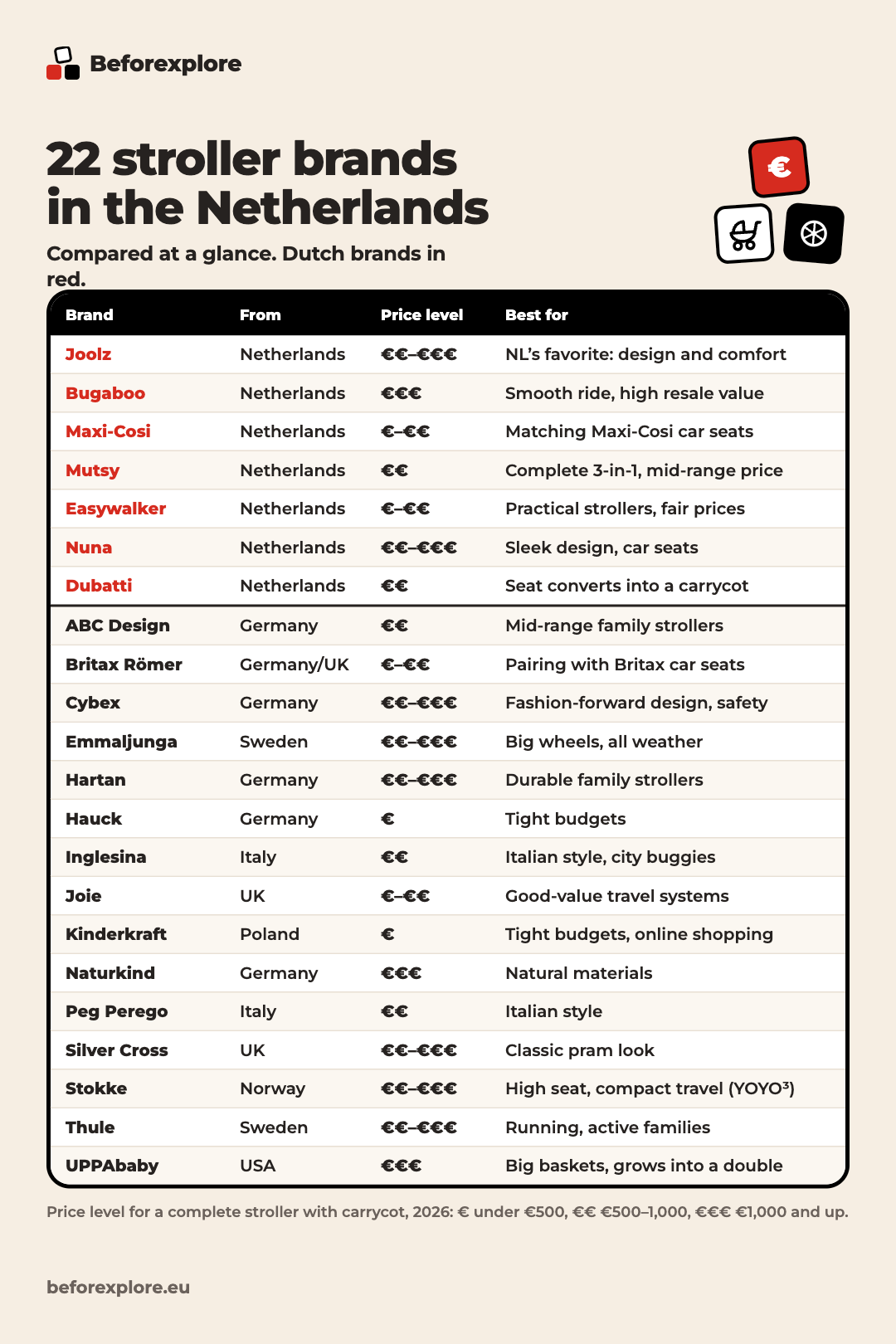
Prices change often and sales are frequent, so treat these levels as a starting point, not a quote.
How to choose a stroller in the Netherlands
Start with your life, not with the brand: where you live, how you get around, and where you'll walk. The right stroller for a canal-house flat is not the right one for a village near the dunes.
- Your stairs and front door. Dutch staircases are famously steep. If you live upstairs without a lift, every kilo counts: a Mutsy Nexo+ weighs about 10 kg, a Dubatti One E6 about 14.5 kg. Also check that it fits through your door and into your hallway or storage room (berging).
- How you get around. Driving? Fold it and check it fits in your trunk with room for groceries. Taking trains, trams and buses? A compact fold and low weight matter more than big wheels.
- Where you'll walk. Brick-paved streets (klinkers), forest paths and beaches call for bigger wheels and good suspension. In the Consumentenbond survey, parents were least happy with how their stroller handled forest paths, so test on rough ground if you love the woods.
- Wind and rain. Check whether a rain cover (regenhoes) is included, and budget for a footmuff (voetenzak) for winter. Accessories add up fast: parents complained that an original footmuff alone cost almost €100.
Hand muffs are a good idea to add to your babyshower wishlist. Here you can find more ideas.
- Your heights. If you and your partner differ a lot in height, test the handlebar together.
- The fold. Fold and unfold it in the store, ideally with one hand. Consumentenbond also advises checking that it stays closed and stands on its own when folded.
- A second baby. Planning siblings close in age? A stroller that converts into a double saves you buying twice.
Quick picks by situation
Your situation
Upstairs flat, steep stairs
Lighter, compact strollers with a carrycot: Bugaboo Dragonfly Plus, Joolz Hub, Mutsy Nexo+
Forest, dune and beach walks
Big wheels and suspension: Bugaboo Fox 5 Renew, Easywalker Jimmey, Emmaljunga, Thule
Second baby soon
Single strollers that grow into a double: Joolz Geo, Bugaboo Donkey 6, Easywalker Harvey 5, UPPAbaby Vista, Thule Sleek
Frequent flights
Cabin-size travel strollers: Bugaboo Butterfly 2, Stokke YOYO³, Joolz Aer
Tight budget
A second-hand premium stroller, or new from Mutsy, Easywalker, Joie, Kinderkraft or Hauck
What I wish I'd known before buying a stroller
1. Not every baby loves the stroller
This was my biggest discovery, and honestly, a shock: not every baby likes sitting in a stroller and looking around. I had pictured two-hour walks with an audiobook or a series while my baby slept sweetly.
Reality? My kids slept in the stroller for about 40 minutes, then started screaming like there was no tomorrow. And I would race home with a howling baby, to calm them down somewhere familiar and breastfeed.
So don't build all your plans around long stroller walks. Many parents keep a baby carrier as plan B, because some babies who protest in the stroller settle down close to mom or dad.
2. Test strollers in real life
Go and push different strollers in a real store. That's how you'll find the one that feels most comfortable, or simply looks the prettiest to you.
The big baby department stores are Babypark, Baby-Dump and Prénatal: 55% of Dutch parents buy their new stroller at one of these three. Big stores have a test track with bricks, gravel and grass, and you can ask to try lifting the stroller into your own car. Buying several big items in one store? Ask about a discount, because there's usually room to talk.
Want to try many brands in one day? The Negenmaandenbeurs, the big baby fair at RAI Amsterdam every February, has stroller test tracks too.
3. Ask around or buy second-hand
Look among friends, or buy second-hand. Strollers, and especially carrycots, are used for such a short time that they're often in excellent condition.
You'll be in good company: about a quarter of Dutch parents use a second-hand stroller. Look on Marktplaats, in local parent groups, or in Bugaboo's refurbished section. Before you pay, check the brakes, the wheels and the folding lock, and look up the model in Consumentenbond's list of strollers you'd better not buy.
4. Don't overthink it
Don't give this decision more attention than it deserves. It feels like choosing a stroller is the most important thing in the world. Honestly, that time is better spent reading about babies themselves, because that part is anything but simple.
And the numbers back this up: in a Consumentenbond survey, almost every parent was satisfied with their stroller, wherever they bought it.
Frequently asked questions
What are the most popular stroller brands in the Netherlands?
Joolz, Bugaboo and Maxi-Cosi. In Consumentenbond's 2024 survey, 23% of parents had a Joolz, 11% a Bugaboo and 10% a Maxi-Cosi. Mutsy and Easywalker are other well-known Dutch names.
Which stroller brands are Dutch?
Bugaboo, Joolz, Mutsy, Easywalker and Dubatti are Dutch brands. Maxi-Cosi and Nuna also have Dutch roots, though Maxi-Cosi is now owned by the Canadian group Dorel.
How much does a stroller cost in the Netherlands?
A simple buggy costs around €250. A complete stroller with carrycot and seat runs from about €600 to €1,300 or more. Budget extra for accessories like a footmuff, rain cover and car seat adapters.
Do I need a carrycot, or is a reclining seat enough?
For a newborn, a carrycot is the better choice, because your baby can lie completely flat. Even a fully reclined seat stays at an angle of about 150°. Look for a carrycot at least 80 cm long inside, so it lasts until 6 to 9 months.
Is it a good idea to buy a second-hand stroller?
Yes. About a quarter of Dutch parents use a second-hand stroller, and carrycots in particular are often like new. Check the brakes, wheels and folding lock, and look up the model for known safety problems before you buy.
Where can I test strollers in the Netherlands?
In the big baby department stores Babypark, Baby-Dump and Prénatal, which have test tracks with different surfaces. The Negenmaandenbeurs baby fair at RAI Amsterdam, held every February, is another good place to compare many brands at once.
What is a maxi-cosi?
It's the everyday Dutch word for an infant car seat, named after the Maxi-Cosi brand. Many strollers sold in the Netherlands come with adapters, so the car seat clicks straight onto the frame.
When should I buy a stroller?
Give yourself time before your due date. Popular models and colors can take weeks to deliver, and you'll want a relaxed afternoon to test a few in the store first.
About the author
I am Anna, a mom of two and the founder of Beforexplore. I have walked (and sometimes run home) with two babies in a stroller, and I write the guides I wish I would had: real recommendations, not another search.
Choosing diapers works a lot like choosing a stroller: what suits one baby doesn't suit the next. That's why I created the Beforexplore diaper box, with several diaper brands in one box, so you can find your baby's favorite by trying instead of guessing.
Explore parenthood, step by step, box by box.
Add comment
Comments